
Pregnancy Calculator – Find Your Due Date & Timeline
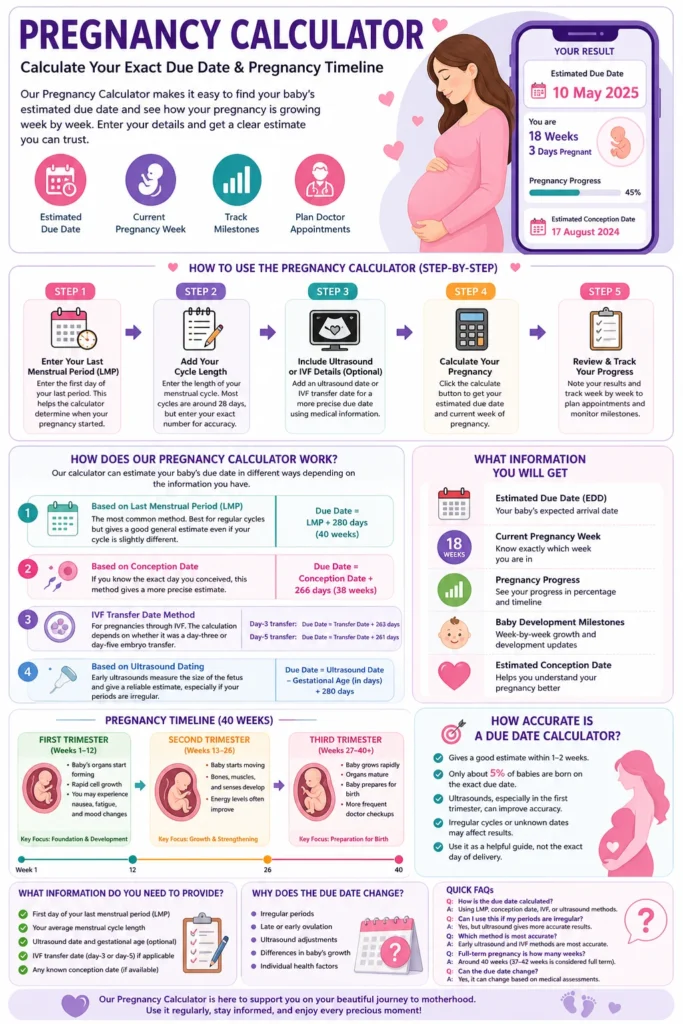
Our Pregnancy Calculator makes it easy to find your baby’s estimated due date and see how your pregnancy is growing week by week. Just enter your last period, cycle length, ultrasound date, or IVF transfer date, and get a clear estimate you can trust.

If you are confused about how to find your pregnancy due date on your own, then our Pregnancy Calculator is here to make it easy for you. Instead of guessing or doing hard date math, you can simply enter details like your last period, cycle length, ultrasound date, or IVF transfer date.
Our tool then gives you a clear estimated due date, which helps you to plan appointments, track progress, and feel more relaxed and confident about what comes next. It also helps you to track important milestones week by week. You can get a close estimate of your baby’s arrival by using accurate information.
Step-by-Step on How to Use the Pregnancy Calculator
Finding your baby’s due date is easier than you think. You do not need to guess or do any hard calculations. Just follow these simple steps, and our pregnancy week calculator will give you a clear estimate of your pregnancy week and due date.
Step 1: Enter Your Last Menstrual Period (LMP)
The first thing you need to do is enter the date of your last period. This is the most important detail because it helps the calculator to understand when your pregnancy started. You should check that you enter the correct date for accurate results.
Step 2: Add Your Cycle Length
Next, enter the length of your menstrual cycle. Most cycles are around 28 days, but if yours is shorter or longer, then include the exact number. This helps the calculator to adjust your due date based on your body’s natural cycle.
Step 3: Include Ultrasound or IVF Details (Optional)
If you have an ultrasound date or have conceived through IVF, then you can use this information. Including these details makes the estimated due date even more precise. It takes into account medical checks and treatments to give you the best possible estimate.
Step 4: Calculate Your Pregnancy
After entering all the information, click on the calculate button. The tool will quickly give you an estimated due date and show which week of pregnancy you are in. It will also give a simple breakdown of your pregnancy stages.
Step 5: Review and Track Your Progress
Once you get your results, you can note them down or use the calculator regularly to track your progress. Knowing your pregnancy week by week helps you to plan doctor visits, monitor milestones, and stay informed about your baby’s development.
How Does Our Pregnancy Calculator Work?
Our week to week pregnancy calculator can estimate your baby’s due date in different ways depending on the information you have. Each method is designed to give you the most accurate estimate possible.
Based on the Last Menstrual Period (LMP)
This is the most common way to calculate a due date. You enter the first day of your last period, and our Period Calculator counts forward to estimate your due date. It works best if your periods are regular, but even if your cycle is slightly different, it can still provide a useful estimate of your pregnancy timeline. The calculator adds 280 days, or 40 weeks, from the first day of your last menstrual period to predict when your baby may arrive.
Due Date = LMP + 280 days (40 weeks)
IVF Transfer Date Method
The exact date of embryo transfer is used for pregnancies through IVF. The calculator then counts forward based on whether it was a day-three or day-five transfer. This method is very accurate and removes the guesswork that comes with natural cycles because the date of conception is known. The calculation depends on whether it was a day-three or day-five embryo transfer.
Day-3 embryo transfer: Due Date = Transfer Date + 263 days
Day-5 embryo transfer: Due Date = Transfer Date + 261 days
Based on Ultrasound Dating
Ultrasound scans can also help to determine your due date, particularly if your periods are irregular or you are unsure of conception dates. Early ultrasounds in the first trimester measure the size of the fetus and give a reliable estimate of how far along the pregnancy is. This method can sometimes be more accurate than using the last period alone
Due Date = Ultrasound Date − Gestational Age (in days) + 280 days
How Accurate is a Pregnancy Due Date Calculator?
A Pregnancy Due Date Calculator gives a good estimate of when your baby might arrive, but it is not 100% exact. Most calculators use methods like your last period, conception date, IVF transfer, or ultrasound to calculate the due date. These estimates are mostly accurate within a week or two.
The accuracy depends on the information you provide. For example, if your periods are irregular or you are unsure about the dates, then the estimate may be slightly off. Ultrasounds, especially in the first trimester, can improve accuracy because they measure the baby’s growth directly.
Remember, only about 5% of babies are born on their exact due date. The calculator is a helpful guide to plan your pregnancy, track progress, and stay prepared, but it should not be treated as the exact day your baby will arrive.
What Information Will You Get From This Pregnancy Calculator?
You can get clear and helpful details about your pregnancy by using this Pregnancy Calculator. First, it gives your Estimated Due Date (EDD), which tells you when your baby is likely to arrive.
It also shows how many weeks pregnant you are and which trimester you are currently in. You can see your pregnancy progress percentage, so you know how far along you are in the journey.
The calculator can highlight important pregnancy milestones, like when certain developments usually happen, which helps you to plan doctor visits and checkups. It can even give your estimated conception date, which is helpful if you want to understand when your pregnancy began.
Pregnancy Trimesters
Pregnancy is divided into three main stages called trimesters, each with its own changes and milestones.
First Trimester (Weeks 1-12)
This is the beginning of pregnancy. Your body starts to adjust, and the baby’s organs begin to form. Many women experience early symptoms like tiredness, nausea, and mood changes. It is an important time for healthy habits and doctor visits.
Second Trimester (Weeks 13-26)
This is often called the most comfortable stage. Symptoms like nausea usually ease, and you may start to feel the baby move. The baby grows quickly, and features like fingers, toes, and facial structures develop. Many parents also have a detailed ultrasound during this period.
Third Trimester (Weeks 27-40+)
This is the final stage when the baby grows larger and prepares for birth. You may feel more pressure in your belly, and movements can be stronger. Regular checkups are important now to monitor the baby’s position and your health as you get ready for delivery.
Why Your Due Date Might Change?
Your estimated due date is just a guide, and it can sometimes change. This happens because every pregnancy is different. Factors like irregular periods, late ovulation, or errors in tracking your last period can affect the calculation.
Medical checkups, especially ultrasounds, can also adjust your due date. Early ultrasounds are often more accurate than dates based on your period alone. Sometimes, babies grow faster or slower than expected, which can also shift the estimated date.
You should remember that the due date is not an exact day, infact it is a range to help you to plan and prepare for your baby’s arrival.
FAQs
Final Words
The use of our Pregnancy Calculator can help you to know your estimated due date. You can see how many weeks pregnant you are and track important milestones. The exact date may change, but our tool gives you a clear idea and helps you to stay prepared. It makes your pregnancy easier to understand and follow.